This interview was published in October 2024 as part of Danceletter Convos, a long-form interview series for paid subscribers. I’ve brought it out from behind the paywall on the occasion of Voyage Into Infinity’s remount at NYU Skirball, Jan. 16-18, 2026.
I first met the anonymous performance artist known as Narcissister in 2010, when I was trying to get back into dancing after a flirtation with giving it up. Feeling stifled by my years of Irish dance training, I thought the antidote might be to try something radically new. And so I found myself at PMT House of Dance one day, auditioning to be part of a small army of masked backup dancers, or Sisters, in Narcissister’s new neo-burlesque production, This Masquerade.
As a performer in that work, in two runs at different venues, I got to see Narcissister’s singular world up close: the feats of homespun engineering that are her costumes, designed to come off in elaborate stripteases; her precise and acrobatic choreography, which often incorporates, mind-bendingly, the birthing of objects from her vagina; her transformation into, and dismantling of, archetypal female characters, always anchored by the wardrobe staples of a mannequin mask and a merkin (a wig for pubic hair). Throughout her body of work, eroticism, humor, and a love for low-fi spectacle underpin sharp and subversive commentaries on gender, race, sexuality, domesticity, and capitalist consumption. It is always a thrill to see what she’ll dream up next.
For two nights in September, her latest large-scale performance commission (and her first in over a decade), Voyage Into Infinity, packed the house at the cavernous Pioneer Works in Red Hook, Brooklyn. Featuring a trio of doll-like Narcissisters (with Effie Bowen and Jessica Emmanuel joining the lead artist), the show takes inspiration from the 1987 video The Way Things Go, which documents the workings of a Rube Goldberg-esque machine made from simple materials like tires, trash bags, wooden planks, and liquids set aflame. Narcissister first saw the video, by the Swiss artist duo Peter Fischli and David Weiss, as a young dancer in New York, before she had invented the Narcissister character, and she reencountered it years later during the pandemic. “It struck me that this could easily be reconsidered, remounted, as a contemporary feminist work,” she told me when we caught up on Zoom the week after the show.
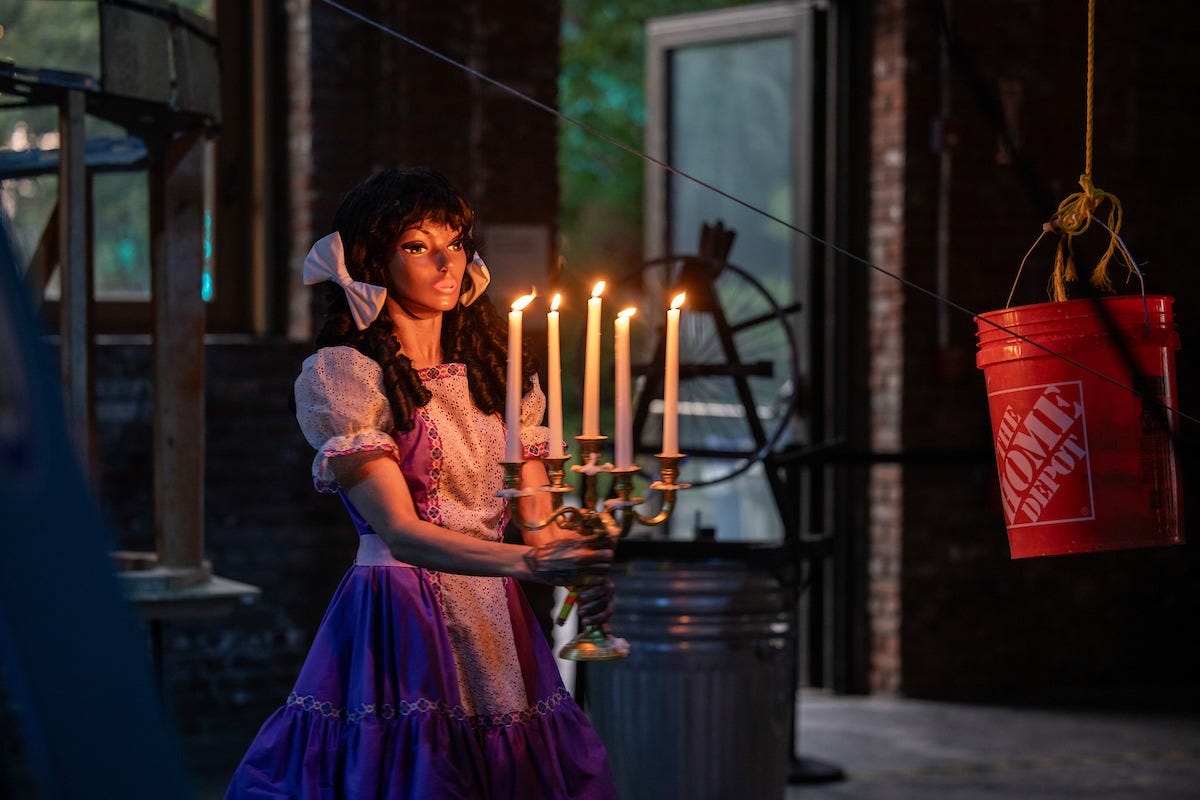
With pyrotechnics by the fire artist Alex Podger and a surprise punk band fronted by Holland Andrews, Voyage unfolds as a series of chain reactions across an orchestra of machines, as precisely rigged as they are rudimentary-looking. Wearing pastel frocks (until they undress, that is) and bows in their hair, the Narcissisters could be plucked from a storybook, their girlish daintiness contrasting with the hulking contraptions around them. But as they buzz about the gaping industrial space, they are in full control, setting off cascades of events through actions like riding a seesaw, stacking buckets, or lighting a rope on fire. Between these explosive moments, whimsical interludes, like a synchronized dance with balloons, add an extra touch of the surreal.
In a nearly two-hour conversation that ranged from topics of fire safety to pelvic floor agility, Narcissister and I spoke about the making of Voyage — its potent imagery and intricate logistics — and how she meets the physical demands of her work. (One of her fitness hacks: an in-home mini trampoline, which she recommends to everyone.)
Voyage Into Infinity seems like such a complex work to pull off. Where did you begin?
Once I got the Pioneer Works commission and knew it was really happening, I started to make a list of ideas with little sketches of chain reaction moments that I was excited to work with, and I kept adding to it over time. I got a residency at the art space KAJE in Gowanus, and I did a work-in-progress performance there to test some of the ideas. Through that, I started to understand what it meant to segue from one idea to the next, because that’s what a chain reaction machine is. You can have a list of wonderful effects that you want to create, but you need to figure out how to get from A to B. And you have to test and retest. Maybe it will work five times, but then the sixth time it fails, and then that means it’s not viable. It takes a lot of patience.
In the early drafting process, what were some of the first ideas that came to you?
A lot of my initial ideas wound up in the final work: the seesaw, the balloons, the cascading rolls of fabric. I thought a lot about the vastness of Pioneer Works and what would be exciting to see there, like riding a bike through the space. I was excited about swings and the motion of swinging — that a performer swinging could trigger another effect to take place. The curtain drop that reveals a punk band — I knew I wanted that. I knew I wanted to use pyrotechnics, so I brought on Alex Podger early in the process. And I knew I wanted to knock a statue off of its pedestal.
Let’s talk about the statue — a replica of The Discobolus — which is an important opening image in the work. One of the first things that happens, if I remember correctly, is that you knock it over, and then each Narcissister steps into its place, taking the same position but holding a dinner plate instead of a discus.
I found the statue in a garden center in Long Island, and I did not know this when I bought it — I just loved the gesture and the look and feel of it — but apparently the original was purchased by Hitler because he felt it was a supreme example of the beauty and majesty of the Aryan race. It is wild how these symbols end up in our life and in culture, and they become kind of divorced from the real complexity or the shadowy histories they hold. I found out about the history as I started to build the show, because I wanted to know more about this figure that I was making so central.
Was knocking it over meant to suggest a toppling of white supremacy, as a kind of framing for the rest of the work?
I wanted to make it broader. It was like toppling oppressive structures, regimes, ways of thinking, hierarchies. I wanted to make it infinitely broad. To someone who doesn’t know the history of the statue, the obvious first impression is that it’s like toppling a formal or oppressive art historical reference or angle — and then with the fact that it’s a man, toppling oppressive notions of gender or gender superiority. I also loved the idea of using dinner plates as a stand-in for the disc, as a nod toward domesticity or stereotypical womanhood or the feminine domain, but also as this thing we all use on an everyday basis — the humble plate. That felt funny and also kind of deep.
Can you describe how the toppling happens, the mechanics of it?
So, the statue is in the space from the beginning of the show, and it’s the only figurative object; everything else is just sort of building materials, ladders, planks of wood, plastic barrels, ropes. At the beginning, one of the Narcissisters, which in this case was me, finds a ladder and lights a rope with a candelabra, and the rope burns through, releasing a heavy punching bag that then flies toward the statue and knocks it over. The statue falls into a swing, and when that swing is yanked, it pulls on a rope in the ceiling that makes a little lever lift, and that lever releases a wooden spool that starts rolling kind of clunkily down an extension ladder that’s suspended in the ceiling. So the wooden spool is rolling down the suspension ladder, and it hits one of the pyro triggers, and there’s a burst of sparks that then triggers the first fabric curtain to unfurl down one of the walls. There are six rolls of fabric rigged up so that when one unfurls, it triggers the second one to roll down to the floor, and so on. So these fabric rolls start consecutively unfurling down the wall, and once the sixth one unfurls, the work continues. That’s the first major machine moment in the piece.
I love hearing you describe that, because when it happens in real time it’s so fast, but when you explain each step, I become aware of all the intricacies.
That’s actually one of the challenges that, to be honest, I’m not sure we completely resolved. It’s hard to direct the attention of the audience toward the working of the machine in each moment. I think maybe if we had more time, that’s something we could dial in a little bit more.
There is a lot of exhilarating pyrotechnic work in the show. What precautions did you have to take around fire safety?
At The Box, where I have a regular gig, there has historically been a lot of fire in shows, with the audience at really close proximity. So I knew there must be a legal way to do this. I asked them about it, and they told me they work with a pyro supervisor, so I engaged that same person, who acts as a liaison between the fire artist and the venue and the FDNY. Everything had to be fireproofed, and there are certain distances at which the pyrotechnics can be fired from the audience. An inspector from the FDNY explosives unit came, and we showed them all the effects we were planning to use, where in the space and at what point in the performance. FDNY was onsite for all the performances, and that was so cool because they loved the show!
Oh wow! What did they say about it?
They were there for our dress rehearsal, and after the show, two of them came up to me and said, “Great show. What is it about for you?” I offered a few thoughts, and then they really wanted to share what it was about for them. It was fascinating. They thought it was about the building of a civilization. So the car tires that the performers rolled back and forth, for them that was about transportation. And the constructing of the pyramids — the bucket pyramid and the wooden pyramid — that was about the building of structures. And then there was war, which was the punk section, and we were fighting to keep our civilization, and at the end it was clear that we had.
It was so cool that they really absorbed the show and were clearly impacted by it and wanted to offer their thoughts and interpretations. I felt like that was a symbol of the show’s success, that it wasn’t just about preaching to the choir of the New York, in-the-know, primarily queer audience that tends to be interested in my work, but it could impact a wide variety of people. That was exciting and satisfying to me.
Preparing for this conversation, I was thinking back to my experience of performing in This Masquerade. I’m not sure if I’ve told you this, but I found wearing the Narcissister mask to be so liberating. Being almost naked onstage but having that protection — it was very freeing. Do you feel protected by the mask?
Oh completely. It’s very protecting. When I started the Narcissister project, I knew that I didn’t want people to see my eyes or the hair on my head or my pubic hair. So I mask my genitals with the merkin, and I cover my face and my hair with wigs and the mask. There’s real intimacy in those sites, and when those sites are masked, I feel very liberated. The meaning of executing certain gestures becomes so much broader. It’s not about me anymore. It’s about this gesture as a person, or as a woman — revealing one’s nakedness or using one’s vagina in an unexpected way. It becomes about the grandness of those gestures in a more general and, I feel, more powerful sense.
Across your work, this show included, I’m always so impressed by your physical strength and risk-taking, from the more gymnastic moments to just generally putting yourself in dangerous situations. And for the stuff involving your vagina, I feel like you must have off-the-charts pelvic floor strength! What do you do to take care of your body, especially as you get older? How do you care for yourself?
Thank you — that’s such a compliment. This show was especially a triumph because I got injured last summer in a performance, pretty severely, with muscle strain and maybe some tearing around my hips. That was really devastating, because I’ve been doing my work for so long without injury, and I feared it was a symbol that because I’m getting older, I wouldn’t be able to do this kind of work anymore.
But I did heal, and I’m so grateful. It just took time. It was very slow. And it was so satisfying to realize that not only did I heal, but I was willing to do “dangerous” things again. When I was climbing up a ladder to test the high swinging moment for this show, I wasn’t even thinking, “Oh, I shouldn’t do this.” I just was thinking, “This is exciting, I can do this!” There were safeties in place, of course, so I wouldn’t hit the floor if I fell. But I was so excited that my body and my whole spirit just wanted to do it and knew that I could. I have a wonderful therapist and she would say, “We can heal! We can heal!” It’s this deep belief she has that if we trust we can heal, then we can. And so I did my best to tell myself that, even when I felt discouraged.
The mental part of healing is so important. And physical therapy, too.
I’ve always been a big believer in physical therapy, and I’m very diligent. If somebody tells me I need to do it, I do it, maybe too much. It’s just the kind of person I am. I love being in my body, I love exercising, I love laying on my floor at night and stretching. I know I need to do this for my work, and there’s a small part of it that’s vanity. But mostly I just love spending time in my body, moving through space, whether it’s swimming laps in a pool or taking a yoga class or jumping up and down on my trampoline at home listening to fun music. Or now, since I got injured, going to a gym and using the elliptical and lifting light weights to rehab and gain strength.
So, wait, you have a trampoline at home?
Yes! A mini one. I highly recommend it. I invested in a good quality one, because I had an idea to use it in a performance. But it was just before the pandemic, and that show ended up not going anywhere. So then I suddenly had this trampoline that I was able to use in my apartment. It’s very good for you, very strengthening, and it’s especially good for your lymphatic system — it’s called rebounding. If you put on music, it’s so fun, like you’re literally jumping for joy. It just works on all the levels.
It’s also great for core and pelvic floor strengthening. As far as the pelvic floor stuff, from the beginning of the Narcissister project, I’ve had a vision to use my orifices in my work. I sit in a lineage of other artists who have done this, so it’s not new to me. And I think it’s very true when they say “use it or lose it.” [Laughs.] I want to keep that aspect of my body and my life alive, so I do my best to celebrate that area of my body and keep it active in a variety of ways, public and personal. It’s important to me.
I remember in rehearsals for This Masquerade, during breaks, you would always have these beautiful homemade meals. Is cooking another way you care for your body?
Totally. I grew up in Southern California in the 1970s, and my mom was really into health food, what is now more mainstream but then was considered more radical. She made all of our food at home, our bread, our mayonnaise, tons of salads. Everything was made from scratch. My oldest memories are that I loved healthy, homemade food.
So yes, I cook most of my food, and I’ve had my own journeys, as most women have, with letting go of control around what I eat. I had moments where I would get into — not really dieting, but more like control, like thinking I had to eat mostly vegetables. I’ve done a lot of work to let go of those notions, but healthful ideas have stayed with me. I take a lot of supplements and try to stay hydrated. I’ve never been interested in alcohol or smoking or drug use; those are just my personal choices. I’ve never had a cup of coffee. I don’t like eating sugar. I tend to be more anxious, so I need food and beverages that help me feel grounded. And I don’t want to suggest I have any answers. I just sort of grope around for what feels good to me and what seems to serve me now.
I’ve been given the gift of the body that I have, that somehow I have a lot of physical capability, and I feel unafraid and bold. I think a lot of this comes from my parents; my dad was very athletic late into his life. Both of them are still so alive in me.
We spoke about one of the first images in Voyage Into Infinity, and I’m also curious about one of the last. You’re strapped on your back to this spinning platform, naked except for the merkin and mask, with a sparkler in your vagina that you light with a candelabra. The punk band is at full throttle, and you’re spinning and spinning, and this flaming Catherine wheel slides down the wall behind you. Then as the spinning slows and the fire dies down and the room grows quiet, pink and white flowers rain onto you from the ceiling. How did this image come about?
It just felt like a righteous ending. The spinning platform is an apparatus I’ve worked with in other performances over the past year; I’ve used it in different forms. And putting the sparkler in my vagina is something I do in a different piece, in a totally different context, so it was already in my repertoire. I thought a lot about including it here. It’s just for effect, and I didn’t want it to feel gratuitous. But it came to me as a strong ending. Again, it felt righteous. The flower fall is also something I’ve included in my work before and have thought about for a long time. It feels beautiful and self-loving and honoring — that at the end of the performance I would shower myself with flowers, not wait or expect that they would come from anywhere or anyone else.
Voyage Into Infinity premiered at Pioneer Works on Sept. 14 and 15, 2024. A solo exhibition of Narcissister’s masks and collages is currently on view at Kendall Koppe in Glasgow, Scotland, through Nov. 16.
Mark Your Calendars
Here are five shows (of so many!) to have on your radar in the next couple of weeks:
Bill T. Jones/Arnie Zane Company, Still/Here, Oct. 30-Nov. 2 at BAM
Netta Yerushalmy, MOVEMENT, Nov. 1-2 at NYU Skirball
Matthew Rushing, Sacred Songs: A Journey of the Spiritual, Nov. 1-3 at the Whitney
Molly Lieber and Eleanor Smith, Prairie Dawn, Nov. 14-16 at Roulette
Ralph Lemon, Tell it anyway, Nov. 14 and 16 at MoMA PS1